
DMA is pleased to announce that the recent DMA mission to Rome came to a successful conclusion and happy return, which augurs well for the upcoming and future plans and initiatives of DMA, whose central mission, in general terms, is to spread DMA’s key ‘clarified’ message: God’s Mercy is Divine Mercy; Divine Mercy is God’s mercy.
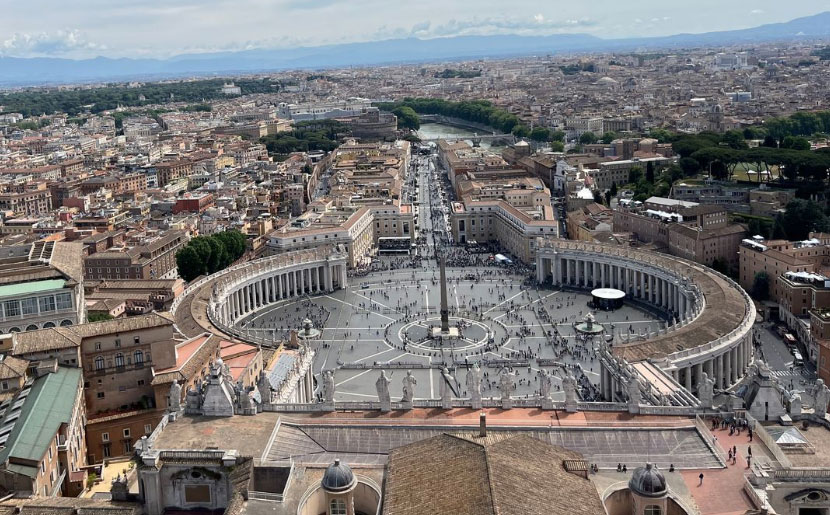
Although there was much uncertainty and no small risk of disappointment surrounding our spontaneous trip to the other side of the world during an as-yet undeclared and indeterminate papal conclave, nevertheless DMA threw chance to the wind, sending three members on a two-week sojourn in the Eternal City.
The principal mission was discuss, test, promote, and garner support/patronage, for the abovementioned ‘clarified message’, and for DMA’s concomitant proposals in support of this message, namely, to make better use of Divine Mercy Sunday, principally as a means of ‘returning the lost sheep’ to the practice of their faith. The mission also hoped to sow the seeds for a future Indian-Pacific regional event of God’s mercy based in Australia with which to celebrate of the 2000th anniversary his Our Lord’s Crucifixion and Resurrection.
The problems addressed with clergy in Rome
The clergy understand better than anyone the various threats and challenges facing the Church today, in a dominant secular culture built on materialistic principles that is increasingly aggressive – and let’s face it – anti-christian, such that it has precipitated a steep decline among baptized Catholics in regular Mass attendance as well as a collapse in the central belief in the Real Presence of the Eucharist. This decline is particularly evident across the West, formerly “Christendom”. The Church is assailed by crisis after crisis, that the media has either invented or magnified beyond all proportion, and the result is always the same – a cleaving off of more and more Catholics from the practice of the faith, and then from the faith itself, leaving them without spiritual recourse in their lives besides the hackneyed seductions – either sterile or hostile, or both – offered by the secular world.
What every heart needs is the love of God, and the God of love is found by seeking His mercy. Each cardinal apprehended immediately, therefore, the wisdom of ‘clarifying the message’ that the popular but niche Divine Mercy emphasizes nothing other than God’s mercy, and is, therefore, the very same message as that which is intrinsic to the Catholic faith. It naturally follows, DMA suggested, that if God’s mercy is most fully available in the sacraments of Reconciliation and the Eucharist, as well as in prayer and works of love, then Divine Mercy is a message to all Catholics, to practice their faith! DMA presented the message of Divine Mercy to the cardinals as a message to return to orthodox and regular Catholic faith and practice.
As such, DMA insists upon the Church’s inspired decision and as-yet-untapped wisdom and foresight in having established Divine Mercy Sunday on the octave of Easter and extending to participants on this feast day the Extraordinary Grace of absolution from sin and from all punishment due to sin which, in spiritual and psychological effect, is akin to a second baptism, or in other words, a sort of ‘baptism for the baptized’. As baptism confers great freedom on joy upon converts, so this extraordinary grace given on Divine Mercy Sunday can become a unique and powerful means of rejuvenating the faith of the ‘lost sheep’, restoring them to the body of the faithful , back under the stewardship of the Good Shepherd.
Meeting Cardinal Stephen Brislin
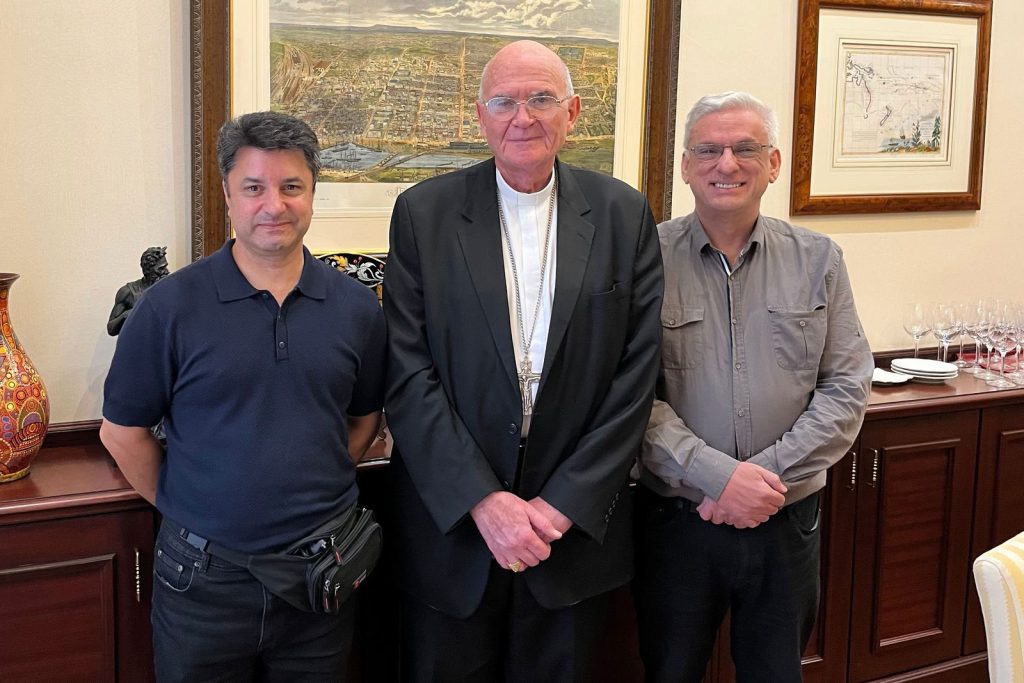
This is the message that DMA brought to its meetings with the Cardinals. South Africa’s Cardinal Brislin, who only recently moved from the Archdiocese of Cape Town to that of Johannesburg, gave a heavy-hearted account of the falling away of the faith in that region. His Eminence confirmed a concomitant rise there in ‘natural religions’, including animism and witchcraft and he has elsewhere been outspoken generally about the challenges facing South Africa, including poverty, corruption, and the need for ethical leadership. As such, he was keen to hear about new approaches to evangelization in such a context.
Meeting at Domus Australia in the Castro Pretorio neighbourhood of Rome, where the Rector and former private secretary to His Emincence Cardinal Pell, Fr Joseph Hamilton maintains a fine and well-attended ‘Australia’themed’ chapel for English-speaking expatriate Catholics, Cardinal Brislin discussed the DMA team’s recent initiatives centred upon Divine Mercy Sunday, which had justrecently passed. With an emphasis on God’s mercy and the sacramental life as the heart of the Divine Mercy message, His Eminence immediately recognized the wisdom and potential utility of this ‘clarified message.’ Focusing in particular on attracting lukewarm and fallen-away Catholics back to practice of the faith, ie., encouraging the ‘lost sheep’ to return to their shepherd in the sacraments, Divine Mercy Sunday could become a tremendous vehicle for such a rejuvenation.
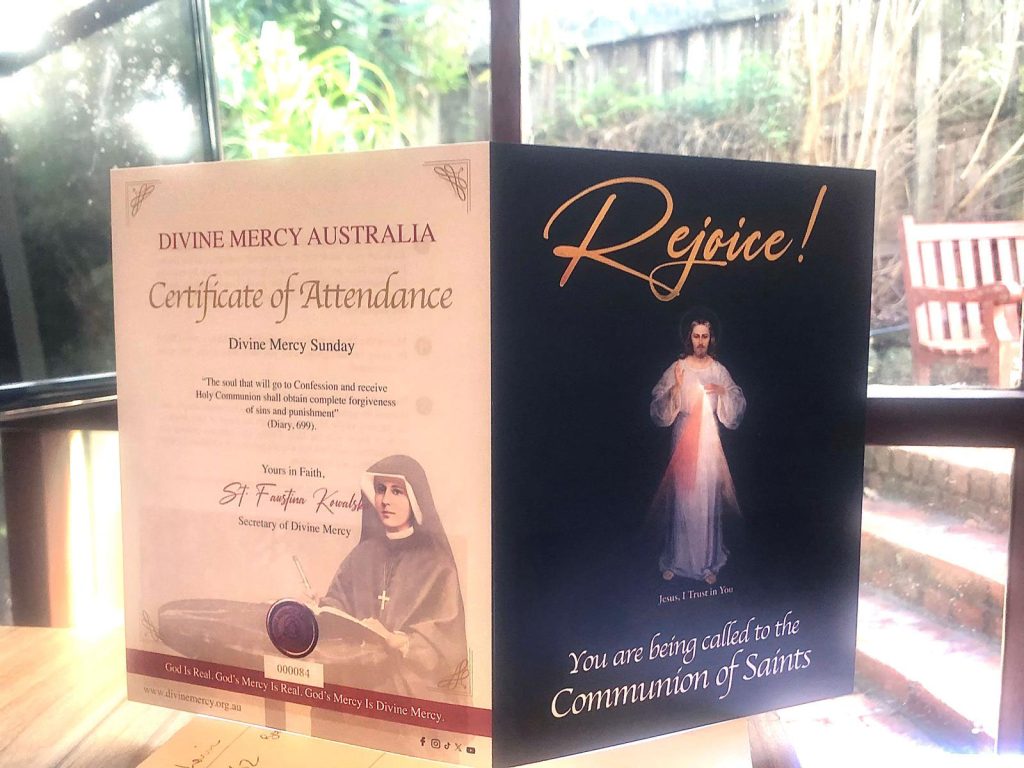
His Eminence was particularly impressed with DMA’s “Rejoice Card”, an example of which was given him as a keepsake. The card, which ‘welcomes’ participants of the extraordinary grace “into the communion of saints”, also teaches participants “how to stay there”, giving practical steps from basic Catholic practice such as regular confession, communion, praying the rosary, etc. The card represents a concrete means of putting Divine Mercy Sunday effectively to the use of the whole Church – not only to the devotees of St Faustina – in its ever-pressing need to re-evangelize’ its own ‘lost sheep’. The credit, DMA emphasized, belongs to the Church herself, in having had the providential foresight in 2000 to establish the octave day of Easter as Divine Mercy Sunday in the first place. DMA’s task is merely to highlight this utility and purpose. His Eminence asked for similar cards to be provided him in, in English and Afrikaans, ahead of next year’s Divine Mercy Sunday, and gave his tacit support for the 2000th anniversary event.
Meeting Cardinal Raymond Burke
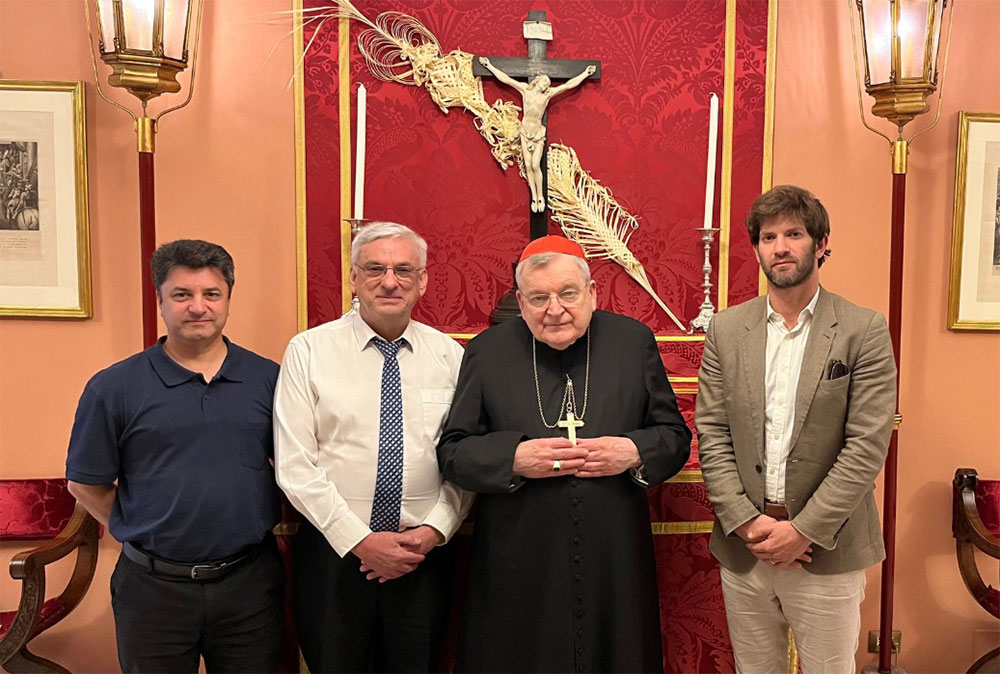
The team next paid a visit to one of the recent conclave’s “kingmakers” and most-eminent members, Cardinal Raymond Burke of the United States. Sitting in the same dignified apartments that had become the centre of political controversy in the final years of the previous pontificate, Cardinal Burke spoke warmly of his support of Divine Mercy (see his 2024 message, see here) and revealed an intimate familiarity with Melbourne’s own Newman Parish, of which one of our team – happy coincidence! – is a member. On this friendly basis, DMA discussed the ‘clarified message’ of Divine Mercy emphasizing God’s mercy; of putting Divine Mercy Sunday – and the Extraordinary Grace available on that day – more prominently and consciously in the service of the Church as a special means rejuvenating the ‘lost sheep’ amongst the faithful, and of DMA’s future plans for a regional event in celebration of the 2000th anniversary of Our Lord’s Crucifixion and Resurrection. His Eminence gave his unqualified support to each, and was happy to put DMA in contact with a number of other cardinals, with whom future meetings are to be confirmed.
Follow-up with meetings in Australia with Archbishop Comensoli
Upon returning to Melbourne, Peter gave his report on the Rome mission to Archbishop Comensoli who was suitably impressed with the outcome. Understanding the import of these meetings in Rome, His Excellency gave his assurance that the Archdiocese would authorize and encourage all of its parishes to make preparations in advance of next year’s Divine Mercy Sunday, and His Excellency would follow along earnestly with DMA’s upcoming initiatives to promote the clarified message of Divine Mercy, that it is, above all, the message of God’s mercy, a mercy which is available most fully in the sacramental life of the Church.
DMA is happy to have secured endorsements from two prominent senior cardinals, +Brislin and +Burke, as well as other senior members of the clergy, with many encouragements and further meetings arranged in the future.